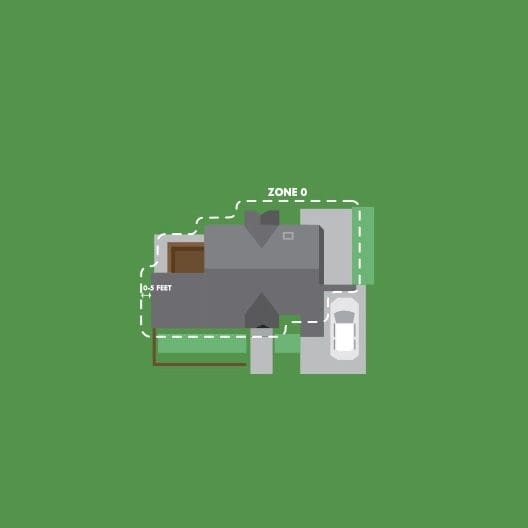
Defensible Space
Before a wildfire reaches your home, it must get close to it. Creating a buffer between your home and adjacent land can reduce the risk of ignition on your property.
In the Zone
To make defensible space more understandable and manageable, a series of zones have been established. These zones are specific to the content in them, and the effect flames and embers may have on adjacent zones (or your home).
Zone 0 refers to the first five feet immediately around a home or other structure, including attached decks, stairs, and the area beneath them. It is the area closest to the building, where embers can ignite nearby combustible material and bring flame or radiant heat directly to the structure. California law directs the Board of Forestry and Fire Protection to establish this ember-resistant zone, and the Board continues to evaluate and refine the details through public workshops and rulemaking discussions.
MySafe:LA continues to meet with residents, fire departments, civic leaders, and government officials as the Board’s evaluation continues. Our approach is practical and based on common sense: start with the simple, affordable, and no-cost steps that reduce ignition potential in the five-foot zone around a structure. Many important actions can be taken now, even as the public process continues.
We know cost is a real concern. Some changes can be expensive, but many are not. Clearing debris, moving combustible items away from the structure, addressing hazards under decks and stairs, and breaking combustible connections—such as where a wood fence or gate meets a home—can meaningfully reduce ignition risk.
Our suggestion overall is: Do one thing!
If you get started, you’re more likely to take further action to reduce the risk of ignition spots adjacent to or on your home.
CHECK OUT THE INTERACTIVE OVERVIEW BELOW.
Click to view each tip. Click again to close.
Top 5 Action Items are Red
1
Eliminate all combustible vegetation
Remove dead plants, dry grasses, brush, and flammable shrubs within five feet of the structure.
Remove combustible ground cover
Replace wood chips, bark mulch, and dry leaf litter with noncombustible materials like gravel, decomposed granite, or bare soil.
Keep the area clear of flammable items
Do not store firewood, cardboard boxes, plastic containers, outdoor furniture cushions, or trash bins in Zone 0.
Maintain a clean roof and gutters
Regularly clear leaves, pine needles, and debris from the roof and gutters to prevent ember accumulation.
Use fire-resistant plants only
If any vegetation remains in this zone, it should be low-growing, widely spaced, and fire-resistant (though ideally, Zone 0 remains plant-free).
Install ember- and flame-resistant vents
Replace standard attic and foundation vents with ones tested and rated for ember resistance, covered with 1/8-inch (or even 1/16th) corrosion-resistant metal mesh.
Harden exterior walls and siding
Use noncombustible or ignition-resistant materials (like stucco, fiber cement, or metal) for the home’s exterior within Zone 0.
Retrofit fences where they attach to the house
Replace the first five feet of wooden fencing where it connects to the home with noncombustible material like metal or masonry.
Seal gaps and cracks
Close openings in siding, eaves, or around windows and doors where embers can enter or lodge.
Avoid overhangs or open decks with exposed joists
Either enclose open eaves and decks with ignition-resistant materials or ensure nothing flammable is stored underneath.
- Remove all dead plants, grass and weeds (vegetation)
- Remove dead or dry leaves and pine needles from your yard, roof and rain gutters
- Remove branches that hang over your roof and keep dead branches at least 10 feet away from your chimney
- Trim trees regularly to keep branches a minimum of 10 feet from other trees
- As noted in Zone 0, move wood (including firewood) to Zone 2
- Remove or prune flammable plants and shrubs near windows
- Remove vegetation and items that could catch fire from around and under decks, balconies and stairs
- Create a separation between trees, shrubs and items that could catch fire, such as patio furniture, wood piles, swing sets, etc.
You’ll see that these zones may overlap a bit, and that’s intentional. California law stipulates that Zone 2 extends from 30 feet to 100 feet from buildings, structures, decks and other construction – or to your property line, whichever is closer. If you have a detached garage or other outbuilding, this Zone requirement is applicable for every structure on your property. Be aware of important Zone 2 factors:
- Cut or mow annual grass down to a maximum height of 3 inches
- Create horizontal space between shrubs and trees
- Create vertical space between grass, shrubs and trees
- Remove fallen leaves, needles, twigs, bark, cones, and small branches if they have a depth in excess of three (3) inches
- All exposed wood piles must have a minimum of 10 feet of clearance, down to bare mineral soil, in all directions
Vertical Spacing
This is just as important as the ground clearance Zones noted on this page. To begin with, make certain that from the ground up to the first allowable branch is at least six (6) feet. If you’re five foot nine inches tall, and there’s a branch touching your forehead when you stand next to a tree, that branch needs to be removed.
Make certain you allow extra vertical space between shrubs and trees. Not doing this creates a “ladder” for flames to climb, which can increase heat and bring the fire closer to your home.
Use the graphic below to determine the best vertical spacing between shrubs and the lowest branches or trees, including this formula: If a five foot shrub is growing under a tree, you’ll need 15 feet (3 x 5 feet) of clearance between the top of the shrub and the lowest tree branch.
Horizontal Spacing
There’s a formula for horizontal spacing as well. Horizontal spacing depends on the slope of the land – as the more steep the slope, the faster a fire can move. Take a look at the chart below to determine the best horizontal spacing for materials on your property.